






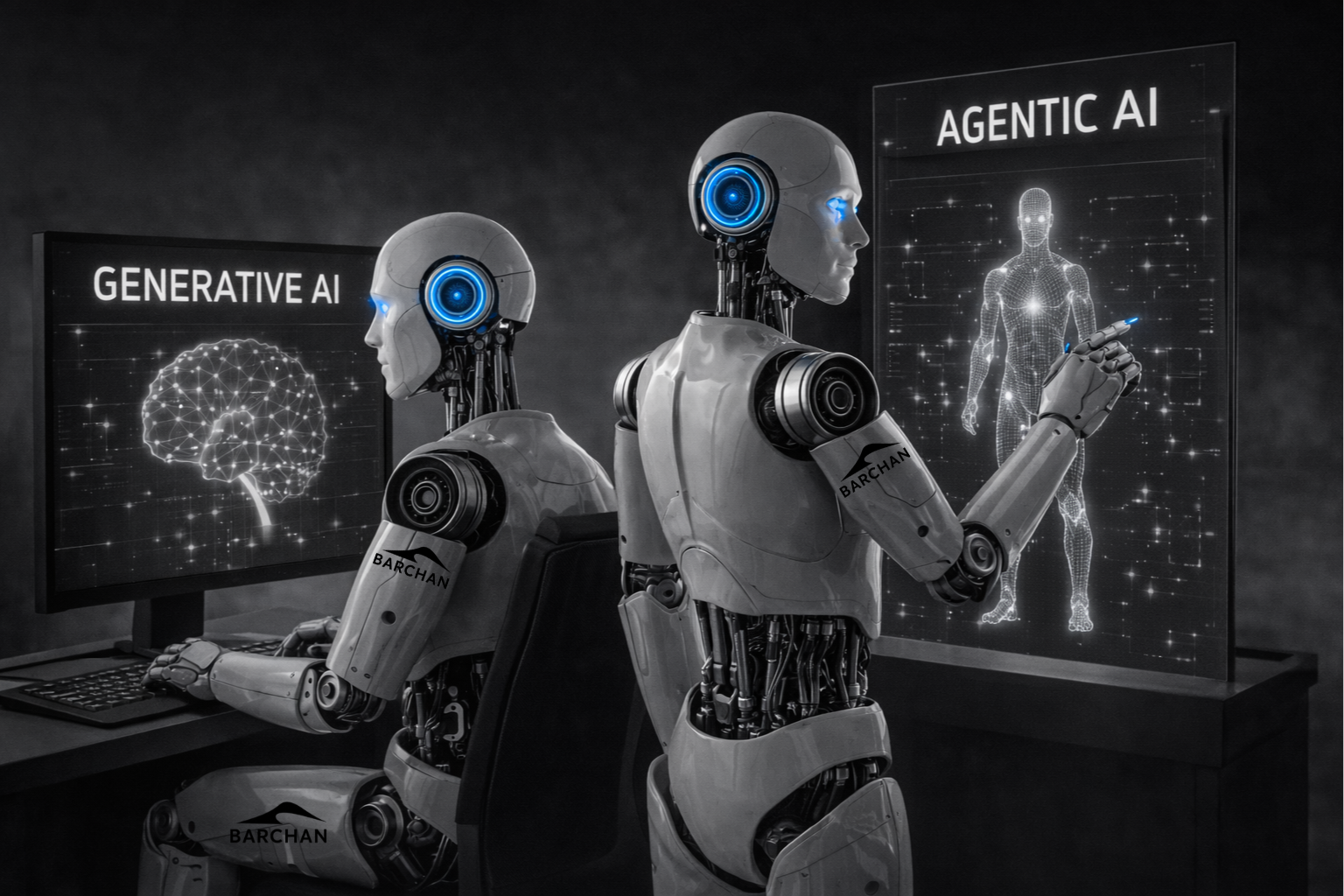

Artificial Intelligence (AI) is evolving at a rapid pace. Only a few years ago, most discussions centred around automation and predictive analytics. Today, the conversation has shifted to two major paradigms: Generative AI and Agentic AI.
Understanding the distinction between these two is essential for business leaders, technology teams, and decision-makers who want to adopt AI strategically rather than reactively.
What Is Generative AI?
Generative AI refers to artificial intelligence systems that create new content based on patterns learnt from data. These systems are trained on large datasets and can produce outputs that resemble human-created material.
Common examples include:
- Text generation (reports, emails, blogs)
- Image creation
- Audio and music composition
- Video generation
- Code generation
Key Characteristics of Generative AI
- Prompt-driven
- The system responds to user inputs or prompts.
- Content creation
- Its primary function is to generate new material.
- Stateless interactions
- Each interaction is typically independent unless memory is explicitly enabled.
- Human-in-the-loop
- The user guides the process step by step.
Business Use Cases for Generative AI
- Marketing content creation
- Customer service responses
- Technical documentation
- Software development support
- Training materials and presentations
Generative AI is excellent at speeding up knowledge work and increasing productivity.
What Is Agentic AI?
Agentic AI represents the next stage of AI evolution. Instead of simply generating content, AI agents can plan, decide, and act to achieve specific goals.
An AI agent is a system that:
- Understands an objective
- Breaks it into tasks
- Executes those tasks
- Monitors results
- Adjusts actions as needed
In simple terms:
- Generative AI answers questions
- Agentic AI gets things done
Key Characteristics of Agentic AI
- Goal-oriented behavior
- The system works towards defined objectives.
- Autonomous task execution
- It can perform multi-step processes without constant human input.
- Tool and system integration
- Agents can interact with databases, APIs, software platforms, and enterprise systems.
- Continuous decision-making
- The agent evaluates outcomes and adapts its actions.
A Simple Analogy
Imagine two employees:
- Generative AI is like a highly skilled writer. You ask for a report, and it produces one quickly and accurately.
- Agentic AI is like a project manager. You give it a goal—“launch a new product”—and it:
- Conducts research
- Creates a plan
- Assigns tasks
- Tracks progress
- Adjusts the strategy
Real-World Business Examples
Generative AI in Action
- Drafting marketing campaigns
- Writing technical manuals
- Creating product images
- Generating code snippets
Generative AI in Action
- Managing procurement processes
- Monitoring supply chains and triggering orders
- Handling customer support cases end-to-end
- Running automated compliance checks
- Orchestrating digital marketing campaigns
Why Agentic AI Is the Next Big Shift
Generative AI has already transformed how knowledge workers create content. However, most business value lies not in content—but in process execution.
Agentic AI enables:
- End-to-end automation of complex workflows
- Faster decision cycles
- Reduced operational costs
- Scalable digital workforces
- Continuous optimization
This is the transition from “AI as a tool” to “AI as a digital teammate.”
How Generative and Agentic AI Work Together
These two approaches are not competitors—they are complementary.
A typical agentic workflow might look like this:
- An AI agent receives a business objective.
- It gathers data from internal systems.
- It uses generative AI to create reports, messages, or analyses.
- It takes actions based on the results.
- It monitors outcomes and adjusts its strategy.
In this model:
- Generative AI is the engine
- Agentic AI is the driver
What This Means for Business Leaders
Organisations are moving through three stages of AI adoption:
Stage 1: AI for Productivity
- Content generation
- Personal assistants
- Knowledge work acceleration
Stage 2: AI for Process Automation
- Automated workflows
- Decision support systems
- Integrated AI tools
Stage 3: AI as Autonomous Agents
- Self-managing processes
- AI-driven operations
- Digital workforces
Most companies today are in Stage 1 or early Stage 2
How Barchan AI Agency Approaches This Shift
At Barchan AI Agency, we help organisations:
- Identify high-value AI opportunities
- Deploy generative AI solutions for immediate productivity gains
- Design and implement agentic AI systems for operational transformation
- Integrate AI safely into existing business processes
Our focus is not just on tools—but on measurable business outcomes.
Final Thoughts
Generative AI changed how we create. Agentic AI will change how we operate. Organisations that understand this distinction—and prepare for it—will gain a significant competitive advantage in the coming years.