





From National Ambition to a Future-Ready SpaceTech Ecosystem
Introduction
Over the past two decades, the United Arab Emirates (UAE) has quietly emerged as one of the world’s most ambitious and strategically focused space nations. While many countries continue to view space primarily through the lens of scientific exploration or national prestige, the UAE has adopted a broader and more integrated vision—one that positions space as a catalyst for economic diversification, technological innovation, industrial development and national resilience.
This transformation has been neither accidental nor incremental. It has been driven by a long-term national strategy that recognises the space sector as a strategic enabler of the UAE’s transition towards a diversified, knowledge-based economy. Space technologies increasingly underpin telecommunications, artificial intelligence (AI), advanced manufacturing, environmental monitoring, autonomous mobility, defence, logistics and digital infrastructure. As a result, investment in space is no longer viewed simply as investment in rockets or satellites; it is investment in the future competitiveness of the nation’s economy.
The UAE’s ambitions extend well beyond achieving notable firsts in the Arab world. Landmark accomplishments such as the Emirates Mars Mission (Hope Probe), the UAE Astronaut Programme and the successful development of indigenous satellite capabilities have established the country’s international credibility. However, these achievements represent only one phase of a much broader national journey. Today, the UAE is actively building an integrated SpaceTech ecosystem encompassing satellite manufacturing, Earth observation, geospatial intelligence, secure communications, AI-enabled data analytics and commercial space services.
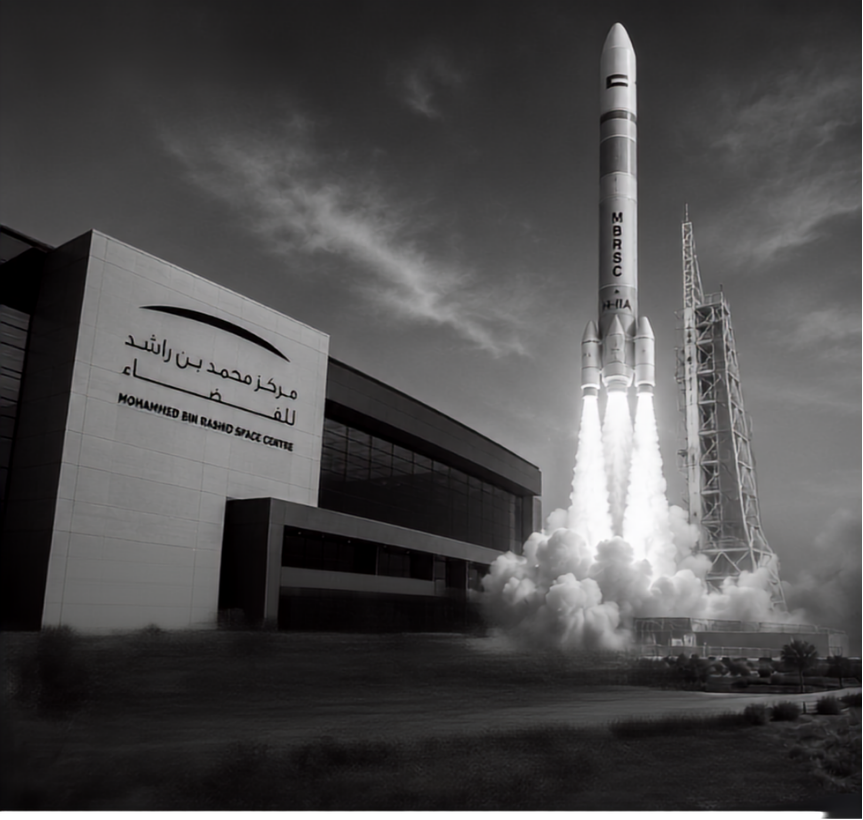
Government strategy, sovereign investment and private-sector innovation are increasingly working in tandem to accelerate the sector’s development. Organisations such as the UAE Space Agency, the Mohammed Bin Rashid Space Centre (MBRSC), Space42, EDGE, Orbitworks and a growing network of start-ups, universities and international partners are collectively transforming the UAE from a participant in the global space industry into an emerging producer of advanced space technologies.
International collaboration has been a defining feature of this transformation. Rather than attempting to develop every capability independently, the UAE has deliberately pursued partnerships with leading governments, research institutions and commercial companies. This collaborative approach has accelerated technology transfer, strengthened domestic capabilities and enabled Emirati organisations to participate in some of the world’s most advanced space programmes. Increasingly, however, these partnerships are evolving from capability-building initiatives into industrial collaborations focused on manufacturing, commercialisation and export growth.
The UAE has also articulated ambitious long-term economic objectives for the sector. Through the National Space Strategy 2030 and more recent initiatives aimed at expanding investment, fostering innovation and supporting private enterprise, the government has set a clear course towards establishing the UAE among the world’s leading space economies. The emphasis has shifted from demonstrating technical capability to creating sustainable economic value through advanced manufacturing, commercial services, intellectual property and high-value employment.
This evolution reflects a broader global trend. As the international space economy moves towards an estimated value exceeding US$1 trillion by 2040, competition is no longer defined solely by the number of launches or planetary missions. Instead, nations are increasingly competing to develop integrated industrial ecosystems capable of designing, manufacturing, operating and commercialising space technologies. In this new environment, success depends on the ability to combine scientific excellence with industrial capacity, commercial innovation and strategic partnerships.
The UAE is positioning itself at the forefront of this transformation. Rather than replicating the approaches of traditional space powers, it has developed a distinct model that combines visionary government leadership, agile policymaking, sovereign investment, international collaboration and private-sector participation. The result is an increasingly sophisticated national ecosystem that supports not only exploration, but also advanced manufacturing, digital transformation, economic diversification and national security.
This article explores how the UAE has evolved from an emerging space nation into one of the Middle East’s most dynamic SpaceTech ecosystems. It examines the institutions, policies and partnerships that laid the foundations of the sector, the transition from government-led programmes to commercial enterprise, the rise of indigenous manufacturing and AI-enabled services, and the strategic role that space is expected to play in the UAE’s economic and technological future.
Building the Foundations of the UAE Space Industry
Although the UAE’s emergence as a space nation has often been associated with the Emirates Mars Mission and the country’s astronaut programme, the foundations of today’s industry were laid much earlier. The evolution of the sector has been characterised by deliberate, long-term investment in institutions, infrastructure and human capital, creating the conditions necessary for the development of a competitive national space ecosystem.
The first phase of this journey centred on satellite communications. During the 1990s and early 2000s, the UAE recognised that space-based communications would become an essential component of economic development and national infrastructure. Investments in satellite telecommunications helped establish technical expertise while providing critical services across government, defence, broadcasting and commercial sectors.
The establishment of the Emirates Institution for Advanced Science and Technology (EIAST) in 2006 marked another significant milestone. Rather than simply purchasing satellites from international suppliers, EIAST was tasked with developing indigenous engineering capability and nurturing a generation of Emirati scientists and engineers. Through close collaboration with international partners, the organisation oversaw the successful development of DubaiSat-1 and DubaiSat-2, providing invaluable experience in satellite design, assembly, testing and operations.
This commitment to capability development culminated in KhalifaSat, launched in 2018. As the first satellite designed and built entirely by Emirati engineers within the UAE, KhalifaSat represented far more than a technological achievement. It demonstrated that the country had successfully progressed from technology acquisition to indigenous engineering and systems integration. The programme also established the skilled workforce and technical expertise that would underpin subsequent developments in satellite manufacturing, Earth observation and commercial space technologies.
Institutional development accelerated in 2014 with the establishment of the UAE Space Agency. Created to coordinate national policy, regulate space activities and strengthen international cooperation, the Agency provided a unified strategic framework for the country’s expanding space ambitions. Its establishment also reflected an important shift in national thinking: space was no longer viewed solely as a scientific endeavour but as a strategic sector capable of supporting economic diversification, technological competitiveness and long-term national development.
One of the distinguishing characteristics of the UAE’s approach has been its emphasis on international collaboration. Rather than attempting to replicate the vertically integrated models adopted by traditional space powers, the UAE deliberately pursued partnerships with leading space agencies, universities and commercial organisations. This strategy accelerated technology transfer while enabling Emirati engineers and researchers to gain practical experience through participation in world-class programmes.
These partnerships were never intended to create long-term dependence. Instead, they served as mechanisms for developing indigenous capability. Over time, the emphasis has progressively shifted from importing technology to co-developing systems, localising manufacturing and creating intellectual property within the UAE. This collaborative model remains a defining feature of the country’s space strategy and continues to shape relationships with international partners today.
From National Space Programme to Commercial Space Economy
The establishment of the UAE Space Agency represented more than the creation of a new government institution; it marked the beginning of a comprehensive national strategy to build a sustainable space economy.
Recognising that long-term competitiveness required more than isolated scientific achievements, the UAE adopted a holistic approach that combined research, education, industrial development, regulation, investment and private-sector participation. This vision was formalised through the National Space Strategy 2030, which identified the space sector as a strategic contributor to economic diversification and innovation.
Unlike traditional space programmes that focus primarily on exploration or defence, the UAE’s strategy recognises that modern space technologies have applications across almost every sector of the economy. Satellite communications support digital connectivity, Earth observation enhances environmental monitoring and infrastructure planning, geospatial intelligence strengthens logistics and national security, while satellite-derived data increasingly powers AI applications, autonomous systems and precision agriculture.
As a result, government policy has evolved beyond supporting individual missions towards creating a complete industrial ecosystem capable of designing, manufacturing, integrating and commercialising advanced space technologies.
A key component of this strategy has been the active encouragement of private-sector participation. Rather than relying exclusively on government entities, the UAE has sought to create conditions that enable commercial companies to invest, innovate and compete internationally. Regulatory reforms, research funding, public-private partnerships and targeted investment programmes have all contributed to the emergence of a growing domestic SpaceTech sector.
The establishment of national funding mechanisms, including initiatives designed to support research, entrepreneurship and technology commercialisation, has further strengthened this ecosystem. Universities have expanded space-related research programmes, while international companies increasingly view the UAE as an attractive location for regional headquarters, manufacturing facilities and collaborative research.
At the same time, sovereign investment institutions have played an increasingly important role in scaling national capabilities. Strategic investments have enabled the creation of globally competitive companies capable of operating across satellite communications, Earth observation, AI, advanced manufacturing and digital infrastructure. These investments reflect a broader recognition that commercial success and technological sovereignty are increasingly interconnected.
This transition from government-led programmes to commercially driven innovation has fundamentally reshaped the UAE’s space sector. Scientific missions and national achievements continue to play an important role in inspiring future generations and enhancing international standing. However, they are now complemented by an expanding commercial ecosystem that seeks to generate long-term economic value through exports, intellectual property, advanced manufacturing and high-value employment.
Perhaps most importantly, the UAE has demonstrated that space can serve as a platform for industrial transformation. Rather than viewing space as an isolated sector, national policymakers increasingly recognise its role in enabling broader economic competitiveness. Investments in satellites, AI, robotics, advanced materials, secure communications and digital infrastructure are creating technological spillovers that benefit industries far beyond the traditional boundaries of the space sector.
As global demand for satellite communications, Earth observation, geospatial intelligence and AI-enabled services continues to expand, the UAE is positioning itself not merely as a participant in the global space economy, but as an emerging producer of advanced technologies capable of serving regional and international markets.
The Rise of UAE SpaceTech Champions
One of the defining characteristics of mature space economies is the emergence of globally competitive national companies capable of developing technologies, delivering commercial services and competing in international markets. Over the past few years, the UAE has deliberately cultivated such organisations, creating a new generation of SpaceTech champions that are reshaping the country’s position within the global industry.
Among these, Space42 represents perhaps the most significant development in the UAE’s commercial space sector.
Created through the merger of Yahsat, one of the region’s leading satellite communications providers, and Bayanat, a leader in geospatial intelligence and artificial intelligence, Space42 reflects a new model of integrated space services. Rather than operating as a conventional satellite company, it combines satellite communications, Earth observation, AI-powered analytics and mobility solutions into a single technology platform.
This integrated approach reflects the changing nature of the global space economy. Increasingly, the value of space assets lies not simply in launching satellites, but in transforming the vast quantities of data they generate into actionable intelligence. Through AI, machine learning and cloud-based digital platforms, satellite imagery and communications can support applications ranging from disaster response and environmental monitoring to logistics optimisation, autonomous transport and national security.
Space42 has positioned itself at the centre of this transformation.
Its satellite communications business continues to provide secure connectivity across the Middle East, Africa, Europe and Asia through the Al Yah and Thuraya satellite systems, supporting government, defence and commercial customers. At the same time, its geospatial intelligence capabilities enable governments and businesses to monitor infrastructure, analyse environmental change, improve urban planning and strengthen operational decision-making.
The company’s long-term agreement with the UAE Government to provide next-generation satellite communications services through the Al Yah 4 and Al Yah 5 satellite programme represents one of the largest strategic investments ever made in the region’s commercial space sector. Beyond providing secure national communications, the programme gives Space42 predictable long-term revenues while supporting continued investment in research, manufacturing and innovation.
Meanwhile, the launch of Thuraya-4, one of the world’s most advanced mobile satellite communications satellites, significantly expands the UAE’s capabilities in mobile connectivity. Designed to support government users, emergency services, maritime operations, aviation and remote industries, the satellite reinforces the country’s growing role as a provider of resilient communications infrastructure for regional and international markets.
The emergence of Space42 demonstrates how the UAE’s space strategy has evolved beyond infrastructure ownership towards creating globally competitive technology companies capable of delivering integrated digital services. Rather than simply operating satellites, the company increasingly generates value by combining communications, data, AI and software into solutions that support governments, businesses and critical industries worldwide.
Space Manufacturing: Building Industrial Capability
While communications and data services represent one pillar of the UAE’s commercial space strategy, the country has simultaneously invested in something equally significant: the industrial capability to manufacture space systems domestically.
Historically, most emerging space nations purchased satellites from established international manufacturers. Although this approach enabled rapid capability development, it created long-term dependence on foreign technology and supply chains.
The UAE has deliberately chosen a different path.
Building on the engineering expertise developed through DubaiSat and KhalifaSat, the country is investing in advanced manufacturing facilities capable of designing, assembling, integrating and testing increasingly sophisticated satellites within the UAE.
One of the clearest examples of this transition is Orbitworks, which is establishing Abu Dhabi as a regional centre for commercial satellite manufacturing.
Rather than focusing solely on bespoke spacecraft, Orbitworks is developing industrial-scale production capabilities designed to support the next generation of satellite constellations. Its facilities are intended to manufacture satellites more efficiently, reduce production times and serve both domestic programmes and international customers.
This shift from engineering individual spacecraft towards industrial manufacturing mirrors developments seen in the automotive and semiconductor industries. As satellite constellations continue to expand globally, manufacturing efficiency, quality control and scalable production have become critical competitive advantages.
Orbitworks’ ambitions extend beyond production alone. Through the development of the Altair satellite constellation and investment in AI-enabled satellite technologies, the company is positioning itself to deliver integrated commercial services rather than simply hardware. This reflects an important evolution in the global space industry, where long-term value increasingly resides in data and digital services rather than physical assets alone.
The localisation of satellite manufacturing also strengthens the UAE’s technological sovereignty. By developing domestic integration, testing and production capabilities, the country reduces dependence on international suppliers while creating high-value engineering jobs and supporting the growth of local supply chains.
Earth Observation: From Images to Intelligence
Few technologies illustrate the changing nature of the space economy more clearly than Earth observation.
Modern satellites continuously generate enormous quantities of imagery and sensor data covering every region of the planet. However, the true value of these systems lies not in collecting images but in transforming raw information into actionable intelligence.
Governments use Earth observation to monitor infrastructure, borders, agriculture, maritime activity and environmental change. Businesses rely on satellite-derived insights to optimise logistics, manage natural resources, monitor construction projects and improve operational efficiency. Financial institutions increasingly use geospatial data to assess economic activity and investment risk, while insurers employ satellite imagery to evaluate disaster impacts.
Artificial intelligence has dramatically accelerated this transformation.
Rather than relying on analysts to manually interpret imagery, AI systems can rapidly detect changes, identify patterns and generate predictive insights across vast geographical areas. As AI capabilities continue to mature, Earth observation is evolving into a strategic decision-support capability that underpins sectors ranging from urban planning to defence.
The UAE has recognised this opportunity and has made Earth observation a central pillar of its long-term space strategy.
Through organisations such as Space42, the Mohammed Bin Rashid Space Centre and the UAE Space Agency, the country is investing in advanced remote sensing capabilities designed not only to support national requirements but also to create commercially valuable products for international markets.
This evolution marks a significant departure from earlier satellite programmes. Whereas previous generations of Earth observation focused primarily on acquiring imagery, today’s emphasis is on integrating satellites, AI, cloud computing and advanced analytics into comprehensive digital platforms capable of delivering real-time insights.
Building Sovereign Earth Observation Capability
As Earth observation has become increasingly important for national security, economic planning and critical infrastructure, the concept of space sovereignty has gained prominence.
Space sovereignty extends beyond owning satellites. It encompasses the ability to design, manufacture, launch, operate and exploit space systems without excessive dependence on external providers. It also requires sovereign control over the data generated by those systems and the industrial capabilities necessary to sustain them over the long term.
The UAE’s response has been the development of a comprehensive sovereign Earth observation ecosystem.
Among the most significant initiatives is the Sirb Programme, which seeks to establish a national Synthetic Aperture Radar (SAR) satellite constellation capable of providing high-resolution imagery regardless of weather conditions or time of day.
Unlike conventional optical satellites, SAR systems can image the Earth’s surface through cloud cover and during darkness, making them particularly valuable for disaster response, maritime surveillance, environmental monitoring and defence applications.
Beyond the operational capability itself, the Sirb Programme is designed to accelerate industrial development within the UAE. It encourages technology transfer, local manufacturing, engineering skills development and collaboration between government, academia and industry.
Complementing this initiative is the strategic partnership between Space42 and ICEYE, which combines world-leading SAR technology with the UAE’s growing manufacturing and operational capabilities. The collaboration extends beyond satellite operations to include local production, engineering expertise and the development of a regional Earth observation ecosystem capable of serving both domestic and international markets.
Collectively, these initiatives demonstrate that the UAE is no longer satisfied with purchasing space services from overseas providers. Instead, it is building sovereign capability across the entire value chain—from satellite design and manufacturing to data analytics and commercial service delivery.
Space, AI and National Competitiveness
Perhaps the most significant development within the UAE’s space sector is the growing convergence between space technologies and artificial intelligence.
Satellites are becoming powerful data-generation platforms, while AI provides the analytical capability required to transform that information into commercial value and strategic advantage. This convergence is creating entirely new industries centred on geospatial intelligence, predictive analytics, digital twins, autonomous systems and real-time decision support.
The UAE has recognised that leadership in tomorrow’s space economy will depend not only on launching satellites but also on controlling the software, algorithms and digital infrastructure that extract value from space-derived data.
Consequently, investment in AI is increasingly being integrated into national space initiatives, creating synergies with broader programmes supporting digital government, smart cities, autonomous mobility and advanced manufacturing.
This convergence also reinforces one of the UAE’s principal competitive advantages: its ability to align long-term government strategy with agile commercial execution. By combining sovereign investment, supportive regulation, international partnerships and private-sector innovation, the country is creating a SpaceTech ecosystem capable of adapting rapidly to changing technological and commercial opportunities.
Rather than treating space as a standalone industry, the UAE increasingly views it as foundational infrastructure supporting the broader digital economy. In doing so, it is redefining the role that space plays within national development—not simply as a domain of exploration, but as an engine of innovation, industrial growth and economic competitiveness.
International Partnerships: Accelerating Capability Through Collaboration
International collaboration has been central to the UAE’s space strategy since its inception. Unlike many established space powers that developed their capabilities over decades through largely domestic programmes, the UAE adopted a more agile and collaborative model, recognising that strategic partnerships could significantly accelerate knowledge transfer, capability development and industrial growth.
This philosophy has underpinned many of the country’s most significant achievements. The Emirates Mars Mission was developed in partnership with leading American universities, enabling Emirati engineers and scientists to work alongside internationally recognised experts while simultaneously building indigenous capability. Similarly, the UAE Astronaut Programme has benefited from extensive collaboration with NASA, Roscosmos and other international organisations, providing Emirati astronauts with access to world-class training and operational experience.
More recently, however, the nature of these partnerships has evolved.
The emphasis has shifted from scientific collaboration towards industrial partnerships focused on manufacturing, commercialisation, technology development and market expansion. Rather than simply acquiring technology, the UAE increasingly seeks relationships based on co-development, joint ventures and long-term industrial cooperation.
The partnership between Space42 and Finland’s ICEYE illustrates this evolution. By combining ICEYE’s expertise in Synthetic Aperture Radar (SAR) technology with the UAE’s growing manufacturing capabilities and commercial ambitions, the collaboration supports not only national Earth observation requirements but also the development of a regional SAR ecosystem capable of serving international customers.
Similarly, Orbitworks has established strategic relationships with global technology partners to accelerate satellite manufacturing within the UAE, while Space42 continues to collaborate with international telecommunications providers, cloud computing companies and AI specialists to expand its commercial service portfolio.
The UAE Space Agency has also signed numerous cooperation agreements with leading space agencies, research institutions and universities around the world, supporting collaborative research, technology exchange and workforce development.
This international outlook reflects one of the UAE’s greatest competitive strengths.
Rather than attempting to replicate every capability independently, the UAE has developed an innovation ecosystem built around collaboration, openness and strategic partnerships. This approach enables the country to access global expertise while simultaneously developing indigenous intellectual property, engineering capability and industrial capacity.
As commercial space activities continue to expand globally, these partnerships will become increasingly important in attracting foreign investment, supporting exports and integrating Emirati companies into international supply chains.
Space, Defence and National Security
The distinction between civilian and defence space capabilities is becoming increasingly blurred.
Satellite communications, navigation, Earth observation, secure data transmission and geospatial intelligence now underpin military operations, border security, maritime surveillance and national resilience. Consequently, many governments increasingly regard space infrastructure as critical national infrastructure requiring sovereign control and long-term investment.
The UAE has recognised this convergence.
Satellite-enabled communications provide secure connectivity for government agencies, emergency services and defence organisations. Earth observation supports border monitoring, maritime domain awareness, infrastructure protection and disaster response. AI-enabled geospatial analytics improve decision-making while strengthening national preparedness.
These capabilities are becoming progressively more important as geopolitical competition extends into the space domain.
The growing collaboration between Space42 and EDGE reflects this strategic convergence. Together, the organisations are developing technologies that combine satellite communications, AI, remote sensing and advanced digital infrastructure to strengthen sovereign capability while creating commercially competitive products for regional and international markets.
EDGE’s dedicated space activities, including FADA, further reinforce the UAE’s objective of developing nationally controlled capabilities spanning satellite payloads, secure communications, advanced manufacturing and space systems integration.
Importantly, these initiatives are not solely defence programmes.
Many of the technologies developed for sovereign requirements also have significant civilian applications in environmental monitoring, infrastructure management, agriculture, disaster response and logistics. This dual-use approach enables government investment to stimulate broader industrial development while supporting commercial innovation.
The result is a more resilient national space ecosystem where commercial success and strategic capability reinforce one another.
Building a National Space Economy
Perhaps the most significant evolution in the UAE’s space strategy is the recognition that long-term success should be measured not only by scientific achievements, but also by economic impact.
This shift is reflected in the country’s ambition to establish itself among the world’s top ten space economies by 2031.
Achieving this objective will require far more than launching satellites or undertaking ambitious exploration missions. It demands the development of an integrated industrial ecosystem capable of generating sustainable economic value through advanced manufacturing, commercial services, exports, research, innovation and private-sector investment.
To support this transformation, the UAE has introduced a range of initiatives designed to stimulate entrepreneurship, attract international investment and strengthen domestic research capabilities. Government funding programmes, regulatory reforms and public-private partnerships are helping create an environment where both established companies and emerging start-ups can thrive.
The economic opportunities are considerable.
Global demand for satellite communications, Earth observation, geospatial intelligence, AI-enabled analytics and secure digital infrastructure continues to grow rapidly. At the same time, the expansion of Low Earth Orbit (LEO) constellations, satellite-enabled Internet services, autonomous mobility and climate monitoring is creating entirely new commercial markets.
The UAE has positioned itself to participate across multiple segments of this value chain.
Companies such as Space42 are expanding beyond traditional satellite operations into AI-powered digital services. Orbitworks is establishing domestic manufacturing capabilities capable of serving both national programmes and export markets. Universities are strengthening research in advanced materials, robotics, AI and aerospace engineering, while government institutions continue to encourage international collaboration and technology commercialisation.
These developments are generating benefits well beyond the space sector itself.
Investment in space supports highly skilled employment, stimulates research and development, strengthens advanced manufacturing capabilities and accelerates innovation across sectors including telecommunications, energy, transport, agriculture, environmental management and digital government.
In this sense, the space industry has become an important component of the UAE’s broader economic diversification strategy.
Rather than existing as a specialised technology sector, it increasingly functions as an innovation platform supporting the development of a knowledge-based economy.
The Future of the UAE Space Industry
The next decade is likely to be defined less by individual flagship missions than by the continued expansion of the UAE’s commercial and industrial space ecosystem.
Satellite manufacturing is expected to become increasingly localised as companies such as Orbitworks expand production capabilities and develop new generations of commercial spacecraft.
Earth observation will continue to evolve through AI-enabled analytics, advanced sensors and sovereign satellite constellations capable of providing real-time information for government and commercial users alike.
Secure multi-orbit communications are also expected to become an increasingly important strategic capability.
Rather than relying on a single class of satellites, future communications architectures will integrate geostationary, medium Earth orbit and low Earth orbit systems to provide resilient, high-capacity connectivity for governments, businesses and consumers.
Artificial intelligence will further transform the sector.
AI-native satellites, autonomous mission planning, predictive maintenance, automated imagery analysis and digital twin technologies will increasingly enable satellite systems to operate more efficiently while generating higher-value services.
The UAE is well positioned to capitalise on these developments through its broader national investments in AI, digital infrastructure and advanced technologies.
Another important area of future growth will be sustainability.
Space technologies are becoming essential tools for monitoring climate change, supporting precision agriculture, managing water resources, tracking emissions and protecting biodiversity. The UAE’s growing Earth observation capabilities will enable the country to contribute meaningfully to both regional and global sustainability initiatives.
International collaboration will also remain fundamental.
As lunar exploration, commercial space stations, in-orbit servicing, space resource utilisation and next-generation communications continue to develop, opportunities for international industrial cooperation are likely to expand significantly.
The UAE’s proven ability to build trusted partnerships positions it favourably to participate in these emerging markets.
Perhaps most importantly, the country’s future competitiveness will increasingly depend upon its ability to integrate multiple technologies—including AI, robotics, quantum computing, cybersecurity, advanced manufacturing and autonomous systems—into a cohesive SpaceTech ecosystem.
Success will no longer be determined solely by the number of satellites launched or missions completed.
Instead, it will be measured by innovation, commercial competitiveness, technological sovereignty and the ability to generate long-term economic value.
Conclusion
Over little more than two decades, the United Arab Emirates has transformed itself from a nation with limited indigenous space capability into one of the world’s most dynamic and forward-looking space economies.
This transformation has been built upon visionary leadership, long-term strategic planning and sustained investment in people, institutions and technology. Landmark achievements such as KhalifaSat, the UAE Astronaut Programme and the Emirates Mars Mission established international credibility while inspiring a new generation of scientists and engineers. More importantly, they created the technical foundation upon which today’s commercial SpaceTech ecosystem is being built.
The UAE’s strategy has now entered a new phase.
Rather than focusing solely on scientific exploration or national prestige, the country is building an integrated industrial ecosystem encompassing satellite manufacturing, Earth observation, AI, secure communications, advanced digital services and commercial innovation.
Companies such as Space42 and Orbitworks illustrate this transition from government-led capability development towards globally competitive commercial enterprise, while initiatives such as the Sirb Programme demonstrate the growing importance of sovereign capability and advanced manufacturing.
Equally significant is the UAE’s ability to combine international collaboration with indigenous capability development. Strategic partnerships continue to accelerate innovation while ensuring that knowledge, technology and industrial expertise are increasingly embedded within the national economy.
As the global space economy expands towards a trillion-dollar market, the UAE is positioning itself not simply as a participant, but as a producer of advanced technologies, commercial services and industrial capability.
Ultimately, the UAE’s greatest achievement may not be reaching Mars or launching astronauts into space.
It may be demonstrating how a relatively young nation can leverage visionary leadership, international collaboration and technological innovation to build an integrated space economy that supports national prosperity, strengthens strategic resilience and contributes meaningfully to the future of the global space industry.
For governments seeking to diversify their economies, businesses exploring new commercial opportunities and nations aspiring to develop indigenous space capabilities, the UAE offers a compelling model of how space can be transformed from an ambitious national programme into a driver of long-term economic growth, industrial competitiveness and technological leadership.